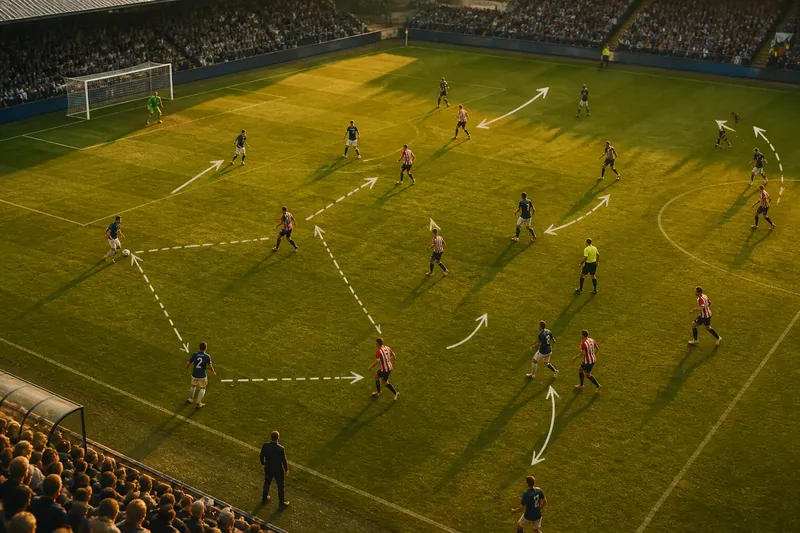
The Scoreboard Before the Electronic Display
Manual scorekeeping turned each update into a visible handoff, helping spectators follow a contest and see how its public account took shape.
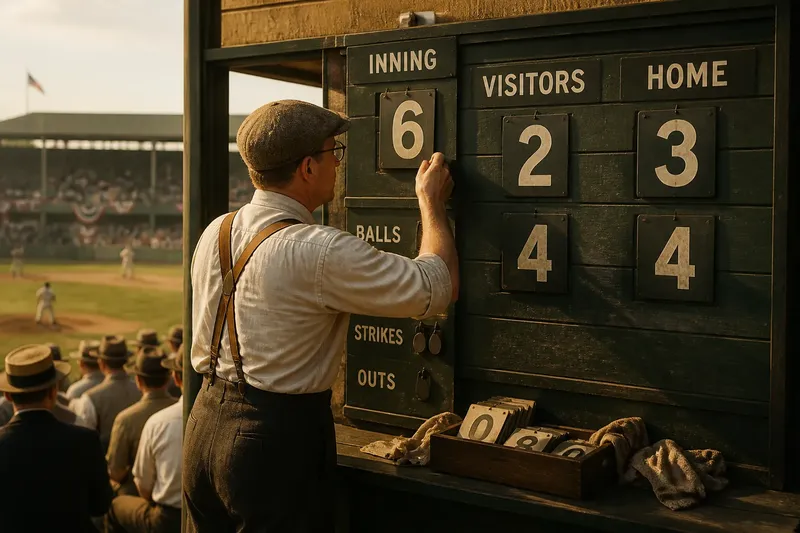
At a baseball ground, a worker turns a panel from one number to the next while spectators watch the play below. Before electronic displays became common, manual scoreboards made the changing result visible through a person’s work: someone interpreted the game’s events, updated the board, and gave the crowd a shared reference.
Manual scorekeeping took many forms, from a chalked slate beside a village field to a large board with removable numerals or hinged panels. Its defining feature was not one particular material, but the human process linking what happened on the field to what spectators could read.
What did a manual scoreboard actually show?
A board’s contents depended on the sport and venue. Some showed only the running score; others included details such as the inning, period, sets, outs, or competitors’ names, helping spectators orient themselves without presenting every event.
Boards could be written on with chalk, updated with cards, or changed by turning numbered panels. At a small event, one person might keep the score on paper and write a summary on the board. The visible display was an edited account, not necessarily a full record of play.
In cricket, for instance, a total and the number of wickets lost can orient a spectator, while a fuller scorebook holds details that would crowd a public board. The scoreboard is useful partly because it leaves things out.
How did a score become public information?
Before an attendant changed a board, someone needed to establish what had happened. Depending on the event, an official’s ruling or a scorekeeper’s record supplied the information; the display keeper then translated it into a form the crowd could read.
Duties could be combined or divided. At an informal match, one person might call out the score, write it down, and update the board. At a more organized venue, an official and scorekeeper might supply the record while a separate attendant handled the display. The precise arrangement varied, but the board depended on human judgment and communication.
Materials shaped the task. Chalk allowed figures to be changed directly, while prepared cards and hinged panels could make numerals clear and reusable. The board’s placement also mattered: the attendant needed access to it, and spectators needed a reasonably clear sightline.
Why did the crowd watch the person updating the board?
A manual update made the passage from play to public record visible. After a disputed point or close finish, spectators could look from the field to the board and wait for the score to be confirmed. The attendant’s movement showed that the result had been received and entered into the contest’s shared account.
A crowd might notice a delayed update, call attention to a figure that looked wrong, or wait for the board to settle before reacting. The board did not decide the score, but the act of reporting it became part of the event’s rhythm.
There could be suspense in the pause before a figure changed. That human pace was not always convenient, and it is not worth romanticizing a delay that left spectators confused. Still, the visible handoff made clear that a person was responsible for communicating the score.
What changed when displays became electronic?
Electronic displays can show information in different combinations, depending on the venue and system. A board may present a score alongside a clock or team names; some systems can also show other material, such as recent events. These features are not universal, and an electronic display does not necessarily receive information directly from an official scoring system.
Where a display is connected to a scoring system, updates may be entered or transmitted electronically. Other setups may require an operator to enter information. In either case, the display itself does not settle disputed calls or replace the rules and authority that determine the score.
The change is also perceptual. A digital display can refresh without an obvious person moving a card or writing a figure, so attention shifts toward the changing information rather than the attendant. The public update becomes less visibly a performance, even though people may still be involved behind the scenes.
How did manual scoreboards shape spectators’ view of a game?
They encouraged spectators to read a contest in layers: watch the play, glance at the score, and use the board to judge whether a moment had changed the situation. The display supported attention without replacing the referee’s gesture, the players’ reactions, or the crowd’s response.
A board showing only a total gave less context than one that also showed an inning or period. A delayed or mistaken figure could prompt questions, reminding spectators that public information was assembled by people and might arrive in stages.
Say you are watching a local hockey match where the attendant records a goal on a sheet, then turns a card on a small board behind the rink. The card changes after a brief delay, and you can see that the goal has narrowed the score; a spectator near the bench may have understood the official’s signal earlier. The same result reaches people through different cues, and the board connects those views.
What do people still ask about manual scorekeeping?
Did the scoreboard keeper decide the official score?
Usually, the display keeper communicated a score established through the event’s official process rather than making that ruling independently. At informal matches, responsibilities could overlap, so the person updating the board might also keep the record.
Were manual boards always updated after every point?
No. A board might show a running total, a partial summary, or selected details, and an update could wait until the attendant could reach it. The scorebook or official record might contain more information than spectators saw.
Why did some boards use cards instead of chalk?
Prepared cards and hinged panels offered reusable figures, while chalk allowed information to be written directly on a board. The better choice depended on the display and the conditions in which people needed to read it.
Are manual scoreboards still used?
Yes. Community grounds, school competitions, and smaller venues may use them when a simple display suits the event. Their continued use can reflect practical needs rather than a deliberate rejection of electronic systems.
What remains of the old scoreboard ritual?
Manual scorekeeping is often described as a slower way to display numbers, but its distinctive feature was the visible handoff from play to record. Spectators could see not only the score, but also that someone was responsible for making it public.
That history offers a useful way to understand any scoreboard: it is a public account shaped by the event’s rules, the information selected for display, and the people who communicate it. At a small match, a clear board and a careful attendant may still be all the occasion requires.