A First Day Watching a Test Match: Follow the Field
Follow the field in a Test match to read how positions, gaps, and small changes shape a batter’s choices and reveal the captain’s plan between deliveries.
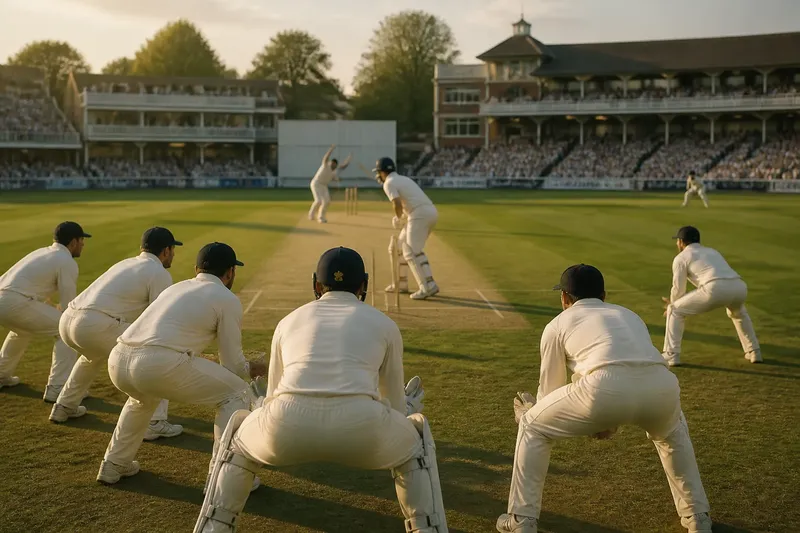
Before a Test bowler begins a run-up, the field can tell you what kind of choice the captain hopes to present. To follow the field in a Test match, watch where the players stand, then connect those positions to the ball, the batter’s response, and any adjustment that follows.
What should you watch before the ball is bowled?
Choose one batter and one bowler to follow. Scan outward from the pitch: wicketkeeper, close catchers, slips, boundary riders, and the open spaces between them. You do not need to name every position; begin by asking which shots the field seems prepared to meet.
A slip cordon stands behind the batter on the off side, where an edge from a ball moving away may travel. A close catcher near the bat can threaten a push or defensive mistake. A deep fielder near the boundary protects against a firmly struck shot, while a vacant patch may invite the batter to aim there if the delivery permits.
Orient the field around the striker’s stance. For a right-handed batter, the off side is to the batter’s left as they face the bowler; for a left-hander, the arrangement reverses. Reorient yourself when the striker changes hands, since the same position name can correspond to a different physical side of the pitch.
How does a field suggest a plan?
Imagine an invented, hypothetical first-day passage: a right-handed batter faces a right-arm fast bowler. Three slips and a gully wait behind the outside edge, a short leg stands close on the leg side, and a deep square leg guards the boundary. The bowler repeatedly lands the ball outside off stump, drawing the batter toward a forward defensive stroke.
The arrangement offers clues, not certainty. Slips and gully suggest that an edge is anticipated or invited; short leg may be positioned for a deflection off the pad or bat. Deep square leg protects against a forceful pull reaching the boundary, while open space on the off side may tempt a drive. The batter still has to judge the ball rather than obey the field.
Watch the deliveries as a sequence. Does the batter leave balls outside off, defend close to the body, or reach for a drive? Each response can shape the bowler’s next choice. A field may invite a shot while protecting against a mistimed version of it.
What does a field change tell you?
In the invented passage, suppose the batter starts driving through the off side and sends one shot safely along the ground. The captain moves a fielder from the slips to a deeper cover position. The expected visible change is that the boundary is better protected there, while the batter faces a different pattern of gaps.
The move can also affect the bowler’s choices. With fewer catchers behind the bat, the bowler might continue outside off stump to deny easy scoring, or alter the line to encourage a shot toward the newly protected area. Watch the delivery after the move rather than treating the captain’s decision as a complete explanation.
Some adjustments are small: a fielder takes a step toward the bat, moves wider, or changes from a catching position to a boundary position. Compare the location before and after, then ask which stroke has become less comfortable or more tempting.
Which details make the field easier to read?
- Check the striker’s stance. If the batter is right-handed, orient the off side to their left and leg side to their right; if left-handed, reverse those directions.
- Find the close catchers. If slips, gully, short leg, or a silly position are occupied, note the edge or deflection the field may be prepared to catch; if none are close, look instead for boundary protection and open spaces.
- Locate the boundary riders. If a deep fielder guards a particular area, expect that route to be harder to turn into a boundary; if it is unprotected, watch whether the bowler directs the batter toward it.
- Check an apparent gap against the delivery. If the batter can reach the ball and place it safely, the space may offer a scoring option; if the ball makes that stroke risky, treat the gap as bait or simply irrelevant.
- Compare the setup after a change. If a new batter, bowler, or end brings different positions, rescan the field; if the arrangement stays the same, test whether the next delivery still fits the previous plan.
- Track the next ball after a move. If its line or length seems to work with the new position, consider the move part of a connected plan; if it does not, keep watching rather than assuming the tactic has succeeded.
It is not worth memorizing the full fielding map at once. A few positions connected to the current bowling plan tell you more than a long list of names detached from the action. Add unfamiliar terms when they matter: point is on the off side near the square, cover is farther forward, and midwicket is on the leg side.
What questions help you follow a Test match field?
Why are there several slips?
Slips are close catchers behind the batter on the off side, where edges may carry. Several slips provide more catching positions, but the bowler still needs to produce a ball that can take the edge.
Why does a captain leave a gap?
A vacant area may lure the batter into a risky shot, or the captain may be protecting a more dangerous scoring zone. Watch whether the bowler aims toward the gap or makes the batter reach for it.
Does a boundary fielder mean the batter should avoid that shot?
Not necessarily. The fielder makes a boundary less straightforward, but the batter may still take a single, find a different angle, or choose the shot when the delivery is favorable.
Why does the field change after a new batter arrives?
A new batter may have a different stance, strengths, or preferred scoring areas, prompting the captain to adjust catching positions or boundary cover. Treat the new setup as a clue and watch the next deliveries to see how it is used.
How does the invented passage resolve?
Continue the hypothetical passage: after the fielder moves to deep cover, the bowler sends a fuller ball outside off stump. The batter resists the drive and leaves it alone. On the next delivery, the bowler comes closer to the stumps; the batter defends, and the close catchers remain in place.
Suppose the bowler then strays onto the batter’s pads and the batter turns the ball into leg-side space for a single. The exchange shows the trade-off: the captain protected one route, the batter found another, and the bowler must decide whether to restore a catcher, adjust the line, or accept the run.
When you follow the field in a Test match, keep the sequence in view: setup, delivery, response, adjustment. Note which choice the positions encourage, what they make costly, and whether the next ball supports that reading; even a quiet spell can reveal how both sides are managing risk.