The Myth of the One Perfect Team Formation
A team formation is a starting arrangement, not a fixed solution. Learn to read its changes as players respond to space, opponents, and the match.
To understand why a team’s shape suddenly looks different after kickoff, start with the formation printed beside its lineup: it describes where players begin, not where they must remain. The one perfect team formation is a myth because opponents, possession, space, and score all change what a useful arrangement looks like.
That does not make formations meaningless. A familiar shape gives players shared reference points: who holds width, who protects the center, and who can move forward when the ball travels. The useful question is not whether a team has chosen the best formation in the abstract, but what it is trying to solve in this match and how its shape changes as play unfolds.
What does a formation tell you before kickoff?
Formation labels usually count players from the back toward the front, leaving out the goalkeeper. In a 4-3-3, for instance, the shorthand suggests four defenders, three midfielders, and three attackers. It is a compact description, not a complete map of roles or movements.
Two teams listed in the same formation can behave very differently. One 4-3-3 may use its wingers to stay wide and stretch the opposing defense; another may ask them to move inside while the fullbacks provide width. The midfielders’ responsibilities can vary just as much: one might sit in front of the defenders, while teammates press high or make forward runs.
Before judging the label, look at the lineup and ask what each player is suited to do. A team with a natural holding midfielder may use that player to shield the defense and release others to attack. Without that role, the same nominal shape could leave the center exposed or require a different player to stay deeper.
How can you read the team’s shape in possession?
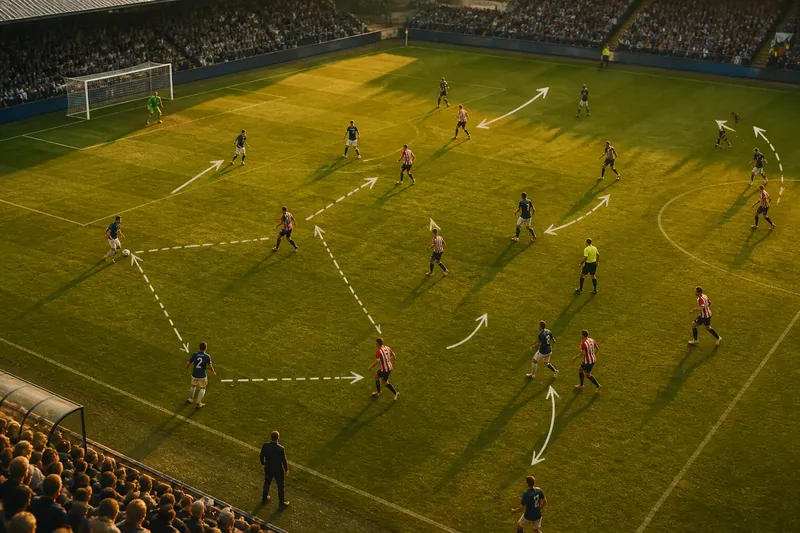
When a team has the ball, watch how it creates passing options rather than trying to match every player to the original diagram. A defender may move wide to receive, a midfielder may drop closer to the back line, and an attacker may come short to connect play. Their movements reshape the formation around the ball.
Start by following the first pass out of defense. Notice whether the goalkeeper or central defenders have a safe route into midfield, whether teammates offer options at different distances, and whether someone stays available on the far side. These clues show how a team intends to progress without requiring you to memorize a tactical code.
Then look at the width and depth of the attack. Wide players can pin defenders near the touchlines, creating room through the middle; a forward who runs behind the defense can stretch the back line even without receiving the ball. If everyone comes toward the same area, the team may have possession but few ways to move forward.
Say you are watching a team listed in a 4-2-3-1 that struggles to build through a crowded center. Imagine its fullbacks move higher and wider, while one central midfielder drops toward the defenders and the wingers come inside. The expected observable change is that the team offers a wider route forward and places more players between the opponent’s lines, though the opponent may then find space behind the advanced fullbacks.
What changes when the opponent has the ball?
A team’s defensive shape is often different from its attacking one. The same winger who moved inside during possession may drop alongside the midfield when the opponent builds from the back. A fullback who attacked aggressively may hold a more conservative position to protect the space behind.
Watch the first line of pressure. Does one forward close down the ball carrier while a teammate blocks the pass into midfield, or do attackers retreat and allow the opponent to advance in front of them? Either approach can be deliberate. Pressing high may force hurried decisions, but it can also leave space behind the press if the opponent plays through it.
Next, notice how the defenders respond to movement. They may step forward together to compress space, or retreat to guard against runs behind them. The midfield line has to connect those choices: if it sits too far from the defense, opponents can receive in the gap; if it drops too deep, the team may struggle to get out after winning the ball.
The formation label rarely captures this full defensive picture. A 4-4-2 can become a narrow block that protects the center, or an energetic pressing shape with forwards steering play toward the touchlines. The difference lies in distance, timing, and responsibility, not just the number of players in each line.
How do you tell a planned change from a broken shape?
Look for repeated relationships between players. If a fullback advances, does a midfielder consistently cover the space behind? When a forward presses, does another player close the nearest passing lane? Repeated support and cover suggest a coordinated plan, even if the overall outline looks unfamiliar.
A shape can also look untidy for a moment because players are reacting to a loose ball, a quick counterattack, or a teammate’s movement. One snapshot does not tell you whether a team has abandoned its plan. Watch the next phase: do players recover their positions, or does the opponent keep finding the same open channel?
Substitutions and changes in the score can alter the assignment. A team protecting a lead may keep more players behind the ball; one chasing a goal may send another attacker forward. The change is not automatically wiser or worse. Ask what risk the team is accepting and whether the new arrangement gives it a way to pursue its immediate aim.
It is not worth the effort to infer a precise tactical system from a single broadcast graphic or freeze-frame. Those views can hide a player’s movement off the ball, while the same positions may serve different purposes depending on who has possession. A few minutes of watching transitions usually tells you more than debating whether the shape deserves one label or another.
Which formation questions help you read a match?
Is a 4-3-3 always more attacking than a 4-4-2?
No. A 4-3-3 can be cautious if its wide players track back and its midfield stays deep, while a 4-4-2 can send both forwards and wide midfielders into aggressive pressure. The players’ duties and the team’s behavior matter more than the formation name.
Why does a formation change during play?
Teams move to create passing routes, protect vulnerable spaces, respond to an opponent’s threat, or make use of a substitution. Those adjustments may alter the visible shape without changing the team’s underlying principles.
Can a team use different shapes in attack and defense?
Yes. A team may spread out to build attacks, then compact its lines when defending, with players shifting between roles as possession changes. That flexibility is one reason a single lineup graphic cannot describe the whole match.
What should I watch if I cannot identify the formation?
Follow the player on the ball and notice who supports nearby, who offers a forward option, and who protects against a counterattack. Then watch how the team reacts when possession changes. Those repeated choices reveal its plan without requiring a label.
How should you use the formation label as a viewer?
Treat the label as a starting clue, then test it against what players actually do. Ask where the team finds width, who protects the center, and how it responds when the opponent breaks its first line. Those questions help distinguish an arrangement from the decisions that give it purpose.
When the shape changes, follow the space that opens as well as the players who move. A fullback’s forward run may create an attacking option and a defensive risk; a midfielder’s drop may stabilize the build-up but leave fewer players between the lines. The formation is not a promise that every problem has been solved. It is the team’s opening way to organize, revise, and negotiate those trade-offs as the match develops.