Advantage or Stoppage: Two Ways to Handle a Foul
Advantage or stoppage in soccer: see what each call preserves and how possession, space, and the available restart shape the referee’s judgment.
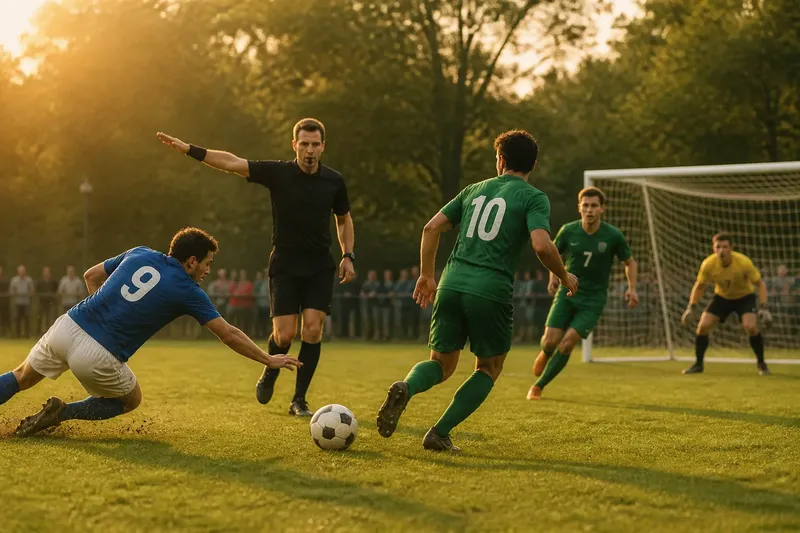
A defender clips a forward, but the ball rolls to a teammate with room to move toward goal. In soccer, advantage or stoppage is the referee’s choice between letting that promising attack continue and stopping play for the restart provided by the rules. The decision weighs the opportunity still available against what a whistle would restore.
Neither choice is simply lenient or strict. The referee considers what the team affected by the foul can realistically do next, while keeping the match orderly and applying the governing rules. The useful question is not whether a foul occurred, but whether the live play or the restart offers the better prospect.
What does advantage preserve?
Advantage allows play to continue after an infringement when the referee judges that the fouled team is likely to benefit. The referee may signal with an arm gesture, but the ball remains live. The foul is not erased; the referee has chosen not to stop play at once.
The benefit might be a clear run toward goal, a pass into space, or possession in a dangerous area with teammates available. A free kick can be useful, but the pause may also give defenders time to recover and organize. Advantage preserves the opening while it remains available.
Continuity matters only if the team can use it. Keeping possession under pressure, far from goal, may offer little practical benefit compared with a restart. The referee judges the opportunity as it develops, rather than assuming that possession alone makes continuing preferable.
What does a stoppage preserve?
A whistle stops the immediate contest and awards the restart required by the rules. For many ordinary fouls, that may be a direct or indirect free kick, depending on the offense; some offenses inside the penalty area can result in a penalty kick. The precise restart depends on the applicable rules and the nature and location of the offense.
Stopping can protect an opportunity when the foul has destroyed it. A player pulled off balance before reaching a dangerous pass may no longer be able to continue the move. Letting play run in that situation could preserve motion without preserving a genuine attacking chance.
A whistle also gives players a clear ruling and a formal way to resume. That can matter when the affected player cannot continue or the ball has moved into a situation where the team has little control. The referee must still apply the rules that govern the particular offense and restart.
How do referees judge advantage or stoppage?
The referee makes the judgment while following the ball, nearby players, and likely next actions. No single position on the field automatically makes advantage the better choice. The comparison is between the quality of the attack that remains and the restart that would follow a stoppage.
- Possession: If the fouled team still controls the ball, the referee can consider whether it can use that control; if possession is about to be lost, a stoppage may be more useful.
- Direction: If play is moving toward a dangerous area, continuing may preserve an attack; if it is moving away from goal, the referee can weigh whether the restart offers a better opportunity.
- Space: If there is room for a pass, dribble, or shot, the live move may be promising; if defenders have closed the route, a whistle may better serve the team.
- Support: If teammates can continue the move, advantage may remain useful; if the player is isolated, the referee can consider whether the live situation has little value.
- Foul and safety: If the offense or circumstances require an immediate stoppage under the applicable rules, the referee must stop play; otherwise, the referee can judge whether allowing play to continue benefits the affected team.
These are considerations, not a mechanical checklist. A team may keep the ball yet have no useful route forward, while a teammate’s touch can create a clear chance. The referee has to judge the likely benefit in the moment, not the outcome that becomes obvious later.
Say a forward is tripped just outside the penalty area, and the ball reaches a teammate facing goal with a clear path to shoot. The referee signals advantage, and the teammate takes a shot that remains available; the attacking move continues without a restart. If a defender instead intercepts almost immediately, the referee’s next decision depends on the applicable rules and the timing of play; players should not assume that every failed advantage can be brought back to the original foul.
When is a restart better than the attack?
A restart may be more useful when a foul leaves the team with possession in name only. Imagine a player stumbles into a defender and the ball rolls toward the touchline as opponents close in. If there is no realistic route to keep the move alive, the referee can judge that stopping play better serves the fouled team, subject to the rules and the circumstances.
The quality of the restart also matters. A foul near the penalty area may create a set-piece opportunity, while one farther away may offer less attacking value. Location alone does not settle the choice: an open attack may be better than a free kick, while a stoppage may be preferable when the live route has disappeared.
There are limits to allowing play to continue. If the rules require the referee to stop play, or an immediate safety concern demands action, an attacking possibility does not override that obligation. Disciplinary action may also be required; its timing and handling depend on the offense and the applicable rules.
Who benefits from each choice?
Advantage can benefit the fouled team when it retains a meaningful, immediate route to attack. It is especially useful when a player has the ball in space, teammates can support the move, and a whistle would allow defenders to recover. The team can pursue the live opportunity instead of exchanging it for a restart that might be less promising.
A stoppage can benefit the fouled team when the infringement has broken the move or left it with little control. For the defending team, a whistle may create time to reset, but that is not the basis for the referee’s decision. The referee considers the affected team’s likely benefit and the requirements of the rules.
The same referee may choose differently as the play changes. A fast transition can make a whistle interrupt a promising break; in a crowded area, the ball may remain technically available while the attacking team has little space or balance to use it.
How should players respond to the signal?
When the referee signals advantage, players should continue playing rather than waiting for a free kick. The signal means play is being allowed to continue; it does not promise that the attack will succeed or that the referee will later return to the original offense.
If the opportunity collapses, players should keep playing unless the referee whistles. Whether the referee can stop play for the original offense depends on the governing rules and the timing and circumstances of the advantage decision. Defenders should also continue to compete within the rules; a signal is not permission to commit another foul.
For spectators, the arm gesture is a useful clue, but the next moments make the judgment easier to read. Watch whether the fouled team keeps the ball, advances into space, or has its route closed. The call is a decision about the play that remains, not a verdict that the initial contact did not matter.
Which choice fits the moment?
Ask whether the team is better served by the play it has now or by the restart available if the referee stops it. If the attack is clear and live, advantage may preserve more. If control, direction, or a usable route has vanished, a stoppage may better protect the opportunity the foul disrupted.
This comparison helps explain a call; it is not a formula players can apply from the sideline. The referee may see pressure or angles that are not obvious from the stands. It is not worth the effort to debate whether a team would have scored from a free kick or from the attack that continued; those alternatives cannot be settled from the play alone.
What do viewers ask about advantage or stoppage?
Can the referee stop play after signaling advantage?
Possibly, but players should not assume the referee can always return to the original offense if the expected benefit fails to develop. The available decision depends on the governing rules and the timing and circumstances; the signal itself does not cancel the foul.
Does advantage mean the foul was minor?
No. Advantage describes how play is managed, not the seriousness of the offense. The referee may allow an attack to continue while still addressing misconduct at an appropriate stoppage when the rules require it.
Can players ask the referee to stop play?
Players can communicate with the referee, but the referee decides whether to whistle and which restart applies. If an advantage signal has been given, continuing to play is the sensible response unless the referee stops the match.
Is advantage always better near the goal?
No. A nearby free kick can be valuable, but a clear live attack may offer a better chance than a set piece. The referee weighs the actual options rather than relying on proximity to goal alone.
In soccer, advantage or stoppage is a choice about what the foul has left the team able to do, within the rules that apply to that match. Advantage preserves a live route forward; a whistle creates the restart prescribed for the offense. For players and viewers, the most useful clue is whether a real opportunity remains after the contact—not simply whether the ball is still moving.